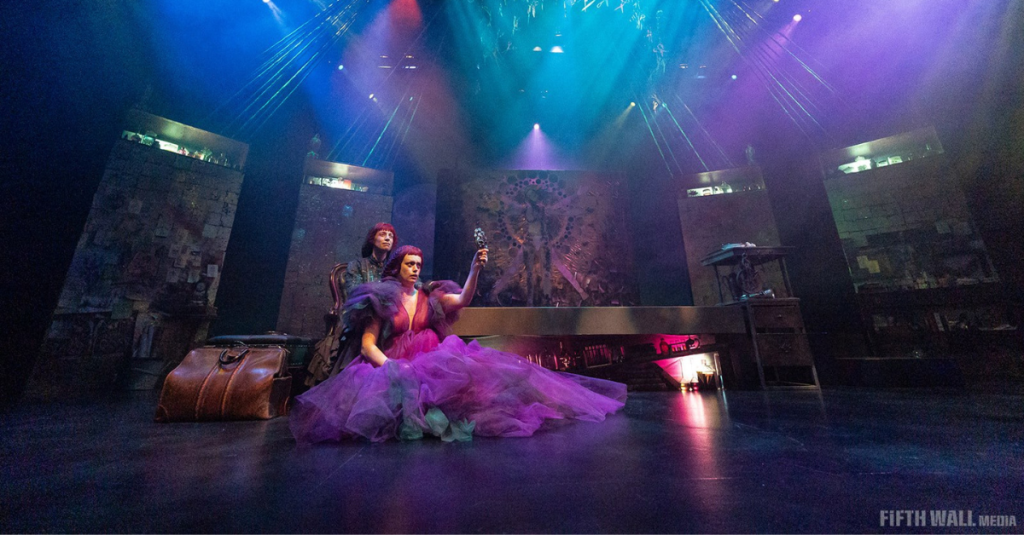
Early in Monstress, a question is spoken that refuses to stay contained. “Am I the monstress?” The line lands not as a confession but as a challenge — one that echoes through the rest of the play and lingers long after the final blackout.
Now onstage at Vertigo Theatre, Monstress is written and directed by Trevor Schmidt, an artist known for centring women’s voices and moral complexity. Gothic in tone and Frankenstein-adjacent in structure, the play is less interested in horror as spectacle than in monstrosity as consequence — what remains after ambition, grief, and self-justification have done their work.
Set in a stylized, non-naturalistic world, Monstress follows a disgraced doctor expelled from the Upper Harrington Academy of Anatomical Dissection and School of Medicine and Surgery for what authorities deemed “dangerous dabbling.” Living outside sanctioned science, she is drawn back into forbidden territory when a wealthy father asks the impossible: to resurrect his daughter, Lydia Chartreuse, who has recently died in a riding accident. When the doctor succeeds — without regard for outcome — the play’s central dilemma crystallizes. Which woman, here, is the monster?
A familiar myth, sharply reframed
Schmidt has long been drawn to Gothic romance: the isolated setting, the displaced young woman, the sense that architecture itself might be watching. Monstress, however, begins with a deliberate act of re-centering. As Schmidt put it, “Most of my work has been centred around women’s voices,” and he was drawn to a story of creator and creation that had “never really been told from a female point of view.”
In Monstress, both the creator and the created are women — a shift that quietly transforms the familiar myth. What might once have read as a cautionary tale about scientific hubris becomes something more intimate and volatile: a study of power, authorship, and emotional obligation. Schmidt describes the dynamic as one that “starts to encompass or mirror a mother–daughter relationship,” a bond thick with expectation, resentment, sacrifice, and the desire to be seen.
The timing of the play’s Calgary run feels uncannily precise. Written two years ago and first staged in Edmonton, Monstress arrives amid a renewed cultural fascination with Frankenstein narratives — and against the sobering backdrop of women’s autonomy being rolled back in legislative and cultural arenas alike. “We’re just in that zeitgeist,” Schmidt noted. “And we’re also seeing so many rights of women being taken away, sadly.”
Vertigo Theatre artistic director Jack Grinhaus was drawn to the work precisely because of that convergence. “The production was highly theatrical and visually stunning,” he said of the earlier staging. “It is a Frankenstein tale told from a unique perspective. There is an intrigue and horror to this story, and it’s perfect for Vertigo.”
Monstrosity as consequence, not spectacle
Despite its Gothic trappings, Monstress resists easy moral sorting. It is structured less around revelation than around consequence — specifically, the cost of choosing oneself in a world that demands care.
“I love shows that make you see a character’s struggle with their responsibility to themselves and their future versus their responsibility to others,” Schmidt said. “And I always particularly appreciate plays where people choose to be selfish and serve themselves at great costs — because I think that’s what real life is like.”
That ethical tension animates Monstress more powerfully than any act of resurrection. The question of who — or what — is monstrous remains deliberately unresolved. The play opens and closes with variations on the same inquiry: What have I become? The refusal to answer it outright is where Monstress finds its unsettling power. It does not exonerate its characters, but neither does it simplify them.
Bodies, power, and performance
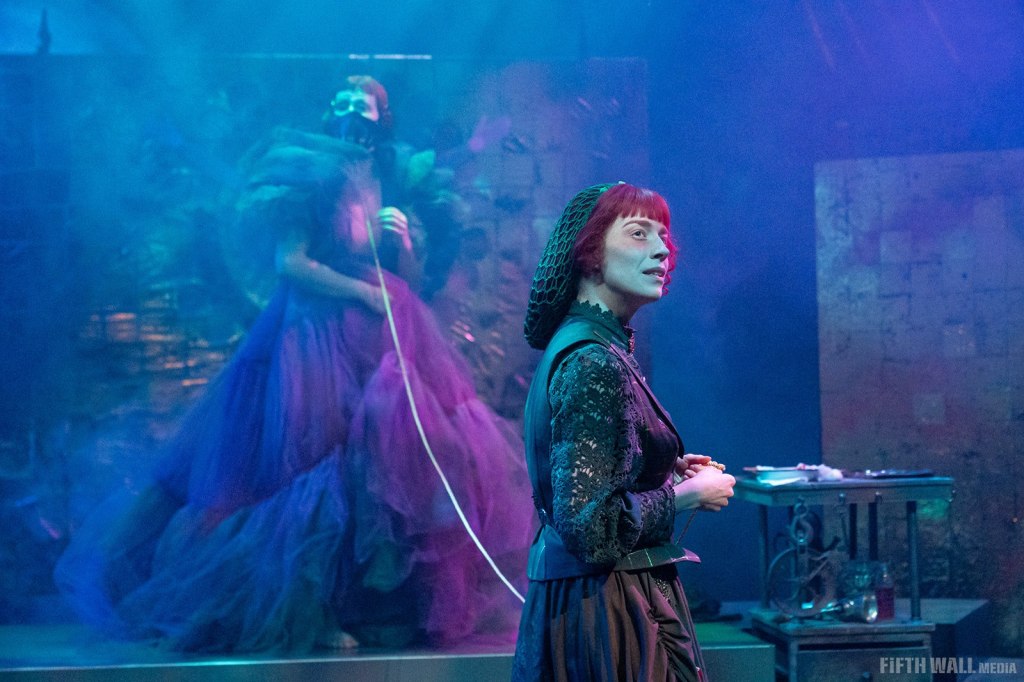
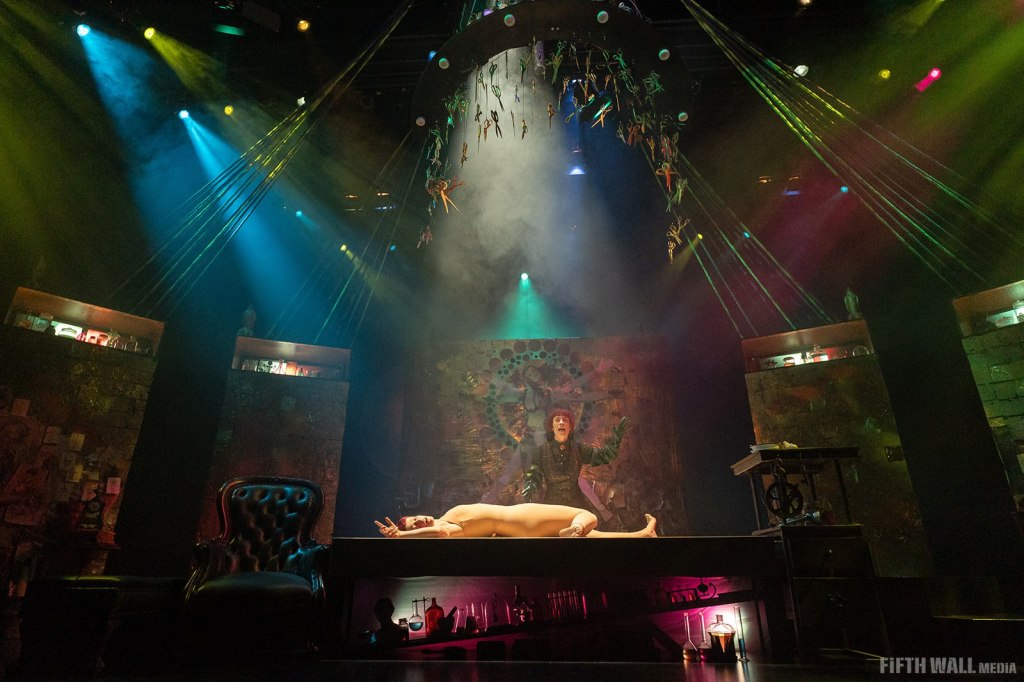
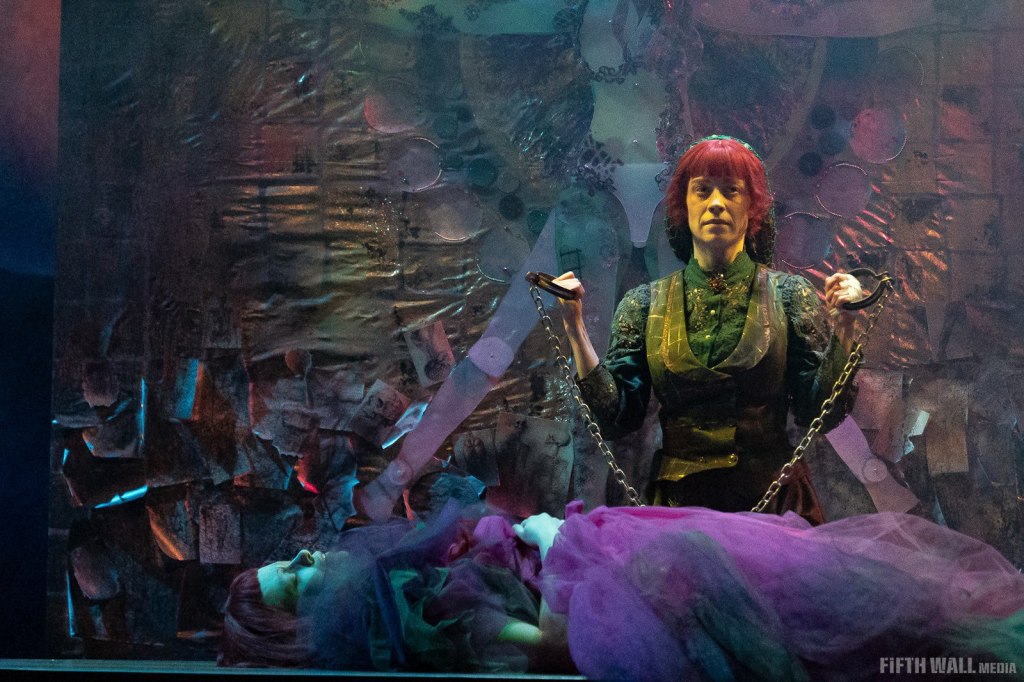
At the centre of Monstress are two women locked in an asymmetrical bond shaped by power, care, and ambition. Sydney Williams plays the Doctor, a figure of intense conviction rather than instability — a woman who believes deeply in her right to create, regardless of cost. Williams resists melodrama, grounding the character’s authority in restraint and precision.
Opposite her is Julia van Dam as The Body, Lydia Chartreuse, the young woman returned to life without consent. Van Dam’s performance carries the play’s emotional volatility: the unease of resurrection, the dawning realization that survival itself may constitute a debt. Together, Williams and van Dam animate the creator–creation dynamic Schmidt likens to a mother–daughter relationship — a bond fraught with expectation, resentment, and dependence.
On opening night, the tension between Williams’s controlled authority and van Dam’s increasingly restless physicality gave that imbalance a visceral charge, grounding the play’s philosophical questions in bodies that seemed constantly at odds with each other — and with the space that held them.
A dark comic-book world
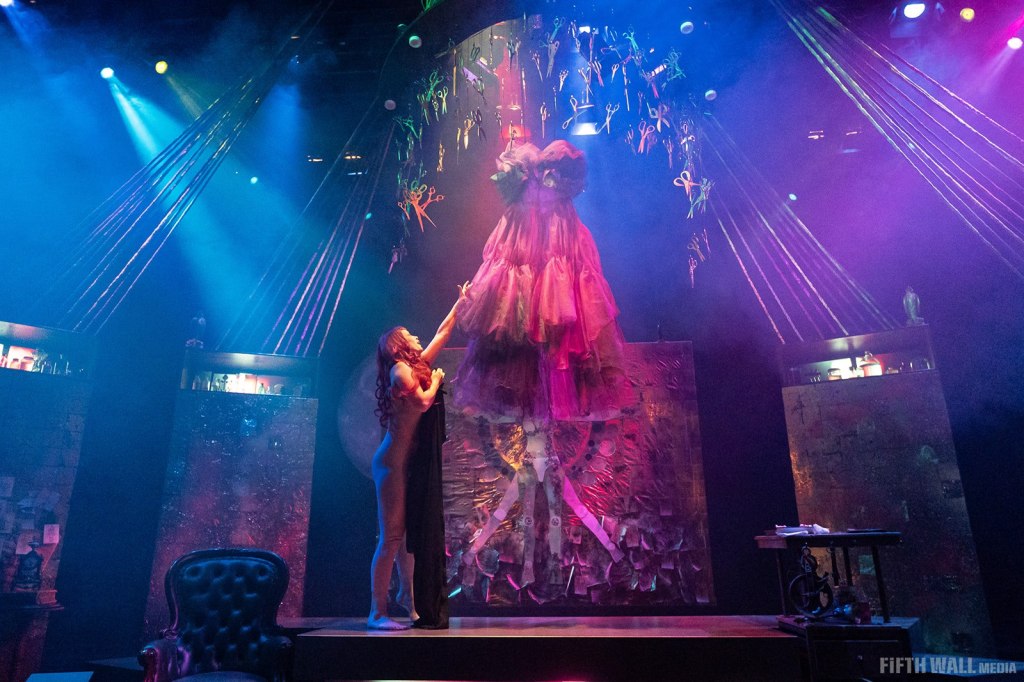
Visually, Monstress announces its intentions immediately. Schmidt, who also serves as set and costume designer, rejects naturalism in favour of heightened theatricality. “I like to free myself from the confines of realism,” he said. “I’m not interested in putting a fully functioning apartment onstage with running water. That’s a movie.”
Instead, the production leans into saturated colour, dramatic silhouettes, and expressive shadow — an aesthetic shaped by Gothic cinema and dark comic books. Lighting by Larissa Poho sculpts the space into zones of threat and intimacy, while sound design and composition by Dave Clarke deepen the atmosphere without overwhelming it. The result is a visual world that refuses realism in favour of emotional legibility — a fitting environment for a play preoccupied with what cannot be contained.
What lingers
Monstress is not a play that reassures. It entertains — briskly and stylishly — but its real ambition lies elsewhere. It asks what happens when creation is severed from care, when ambition outruns responsibility, and when resurrection itself becomes an ethical trespass.
Audiences may leave debating who the monster really is. But the more unsettling question — the one that lingers — is whether monstrosity is something we recognize only after the damage is done.

 Renato Gandia