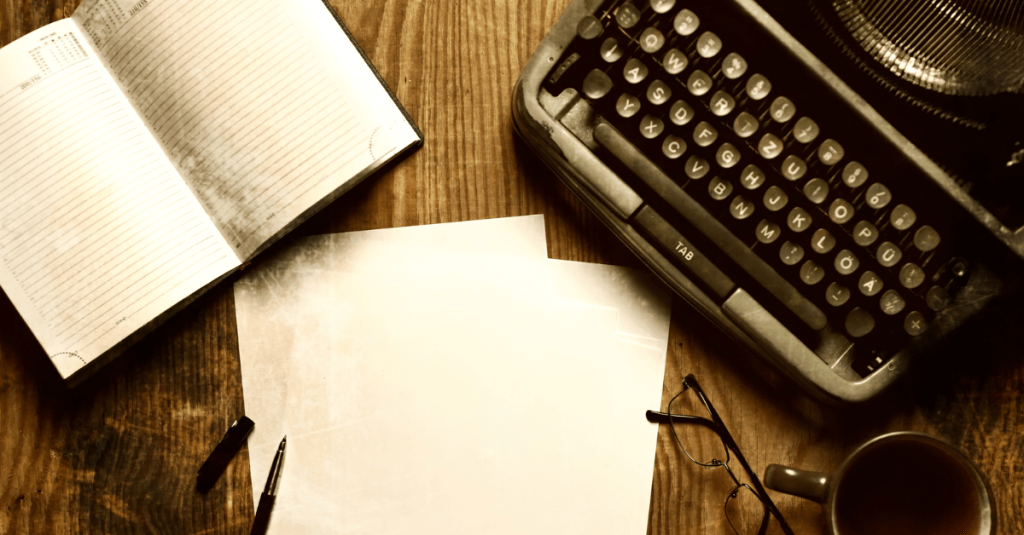
The first short story I ever wrote was typed on a manual typewriter my mother bought me when I was in college. Think early 90s.
I suppose that sentence alone already dates me. It places me in a time before laptops were ubiquitous, before writing felt weightless and endlessly correctable. The typewriter was heavy in a way laptops are not—solid, resistant, loud. Each keystroke required intention, a small commitment of pressure and sound. There was no backspace that truly erased, only correction fluid and the faint ghosts of mistakes underneath. Writing felt physical then: my fingers tired easily, my shoulders stiffened, the bell at the end of each line announcing I had reached the edge and had to decide whether to continue.
These days, Instagram loves the image of a typewriter or a quill. They appear in posts about “the writing life,” as shorthand for seriousness, authenticity, craft. Often, I suspect, they stand in for something few contemporary writers have actually used—an aesthetic rather than a memory.
For me, the typewriter was not a symbol. It was a gift.
I wrote that first story only after my coursework was done, after the day had quieted. I was in seminary then, living among other men whose lives were structured around shared schedules and shared silence. The clacking of a typewriter would have carried down the corridors, disruptive and impossible to hide. So I waited until night and brought the machine into an empty classroom, writing alone while the rest of the seminary slept.
There was something illicit about it, though I wasn’t breaking any rule I could name. It was simply an act that had to be done out of sight. The classroom lights were harsh, the desks too small, the hours borrowed. I wrote quickly, aware of the sound I was making, every sentence announcing itself into the quiet. Writing, then, felt like something I was allowed to do only under certain conditions.
I remember the story clearly. I remember its shape, its ambitions, its awkward earnestness. I remember the quiet astonishment of learning that it would be published in the seminary’s literary journal. There was no launch, no audience beyond our small community. But seeing the story in print—bound, official, given a place—felt momentous. It told me, in a language I could understand then, that what I had made counted.
People who read it told me they loved the story. I remember that clearly too. What I don’t remember is ever asking them why. I didn’t know how to receive praise yet, how to inquire into it without fearing that the answer might undo me. I accepted their kindness silently, almost warily, as if asking questions might expose how little I understood about what I had done.
Looking back, what moves me is not the approval itself, but my distance from it. I was so focused on having finished—on having dared to write at all—that I didn’t yet know how to listen. I didn’t know that loving a piece of writing could mean many things: recognition, identification, gratitude, or simply the relief of being accompanied by words.
That kind of writing—unguarded, unoptimized—feels increasingly rare. Not because it no longer happens, but because so much now surrounds the act of writing before the work has had time to breathe. We are encouraged to explain ourselves quickly, to interpret our work before others have a chance to sit with it, to translate every response into proof.
What the typewriter gave me, unintentionally, was slowness and constraint. It forced me to sit with each sentence longer than I wanted to. It taught me that writing was not about fluency but attention. That words had weight. That beginning something—especially in secrecy—was already enough.
I write very differently now. On a laptop. Faster. More distracted. With a far greater awareness of audience and outcome. And yet, when I think about why I keep returning to the page—especially during periods of doubt—I think less about discipline and more about that first permission. The permission to write quietly, imperfectly, without witnesses—and to let the work mean something to others before I fully understood what it meant to me.
The typewriter no longer sits on my desk. I don’t even know where it is now. But the gesture that brought it into my life remains. Writing, for me, did not begin as ambition. It began as care—someone else’s, extended quietly, without expectation.
When I see images of typewriters now, filtered and staged, I don’t feel nostalgia. I feel gratitude. Not for the object itself, but for what it made possible: a young man in a borrowed classroom, late at night, listening to the sound of his own sentences—and later, hearing that they mattered, even before he knew how to ask why.

 Renato Gandia