
A Freedom to Read event was cancelled in Calgary because it was deemed too political.
That is not a metaphor. That is the logic offered.
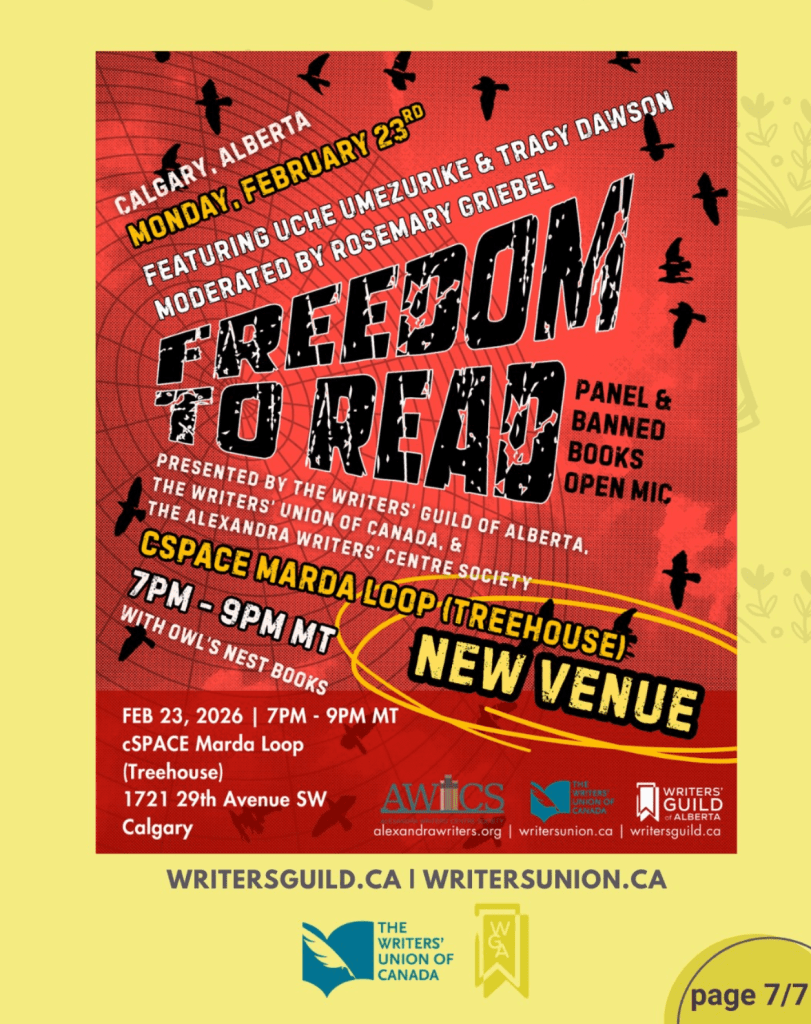
During Freedom to Read Week, an event co-organized by the Writers’ Guild of Alberta and The Writers’ Union of Canada — a public reading and discussion about censorship and book banning — lost its venue at Royal Canadian Legion Branch 264 just over a week before it was scheduled to take place.
A contract had been signed. A deposit paid.
The explanation? The event had “aspects … in conflict with Legion policy, which requires alignment with current government regulations and guidelines.”
Later, Philip Petty, general manager of the branch, told the Calgary Herald that after reviewing the agenda, the Legion understood participants would be asked to contact MLAs about reversing the Alberta government’s decision on the removal of certain books from schools.
“As an apolitical organization that does not host petitions, or political actions of this nature, the branch canceled the booking,” he said. “The branch simply offered the suggestion of a local organization that deals directly with the main topic of the books being removed by the province and was near (the) branch.”
Let us name the political reality plainly: those “current government regulations and guidelines” are shaped by policies advanced by the United Conservative Party government — policies that have led to the restriction and removal of certain books from school libraries, particularly books with 2SLGBTQIA+ themes.
This is not abstract.
This is about which stories are deemed acceptable in public institutions.
“Apolitical” is a political position
Calling an organization “apolitical” does not remove it from politics. It places it in a particular relationship to power.
Contacting an MLA about public policy is not radical activism. It is the most basic expression of representative democracy. It is how citizens signal consent or dissent.
To say that inviting people to write their elected officials constitutes unacceptable “political action” is to redefine civic participation as something suspect.
That is not neutrality.
That is a narrowing of democracy.
When regulations lead to the removal of queer books from schools — and when a venue cites alignment with those regulations as grounds for cancellation — the chain is visible.
Policy shapes atmosphere. Atmosphere shapes institutional caution. Institutional caution reshapes the public square.
You do not need bonfires to silence ideas.
You need compliance.
The public square is being redrawn
Organizers noted that some readings would include queer-themed books — precisely the kinds of titles entangled in Alberta’s current school library restrictions.
When venues begin to hesitate at hosting conversations about those books, the chilling effect is real.
You do not need an outright ban.
You only need:
- A policy that signals risk;
- A venue that fears association; and
- A phrase like “this does not align.”
Add one more:
- A definition of “apolitical” that excludes disagreement with government policy.
And suddenly, the conversation must move elsewhere.
The event will now take place at cSpace Marda Loop. The reading will proceed. That matters.
But relocation is not neutral.
Each time a difficult conversation is displaced, the boundaries of acceptable discourse tighten.
As a writer, I refuse the comfort of neutrality
I write about queerness. About institutions. About what happens when structures claim objectivity while enforcing silence.
To pretend this is not political would be dishonest.
When the United Conservative Party government advances policies that lead to the restriction of important queer books in schools, and when community spaces align themselves with those regulations by withdrawing space from critique, the message is clear:
Some stories are contentious enough to be removed.
Some conversations are political enough to be displaced.
And some forms of civic engagement are inconvenient enough to be excluded.
A democracy that can withstand a book
A confident democracy can withstand a novel about a queer teenager. A memoir about migration. A story about a body that does not conform.
A fragile one cannot.
Freedom to Read Week exists because history shows that censorship rarely begins dramatically. It begins quietly — with policies, with committees, with “alignment,” with caution masquerading as neutrality.
A freedom that cannot tolerate citizens contacting their representatives about books is already thinning.
And when we say “this does not align,” we are not merely talking about policy.
We are deciding whose lives, whose stories, and whose voices belong in the room.

 Renato Gandia