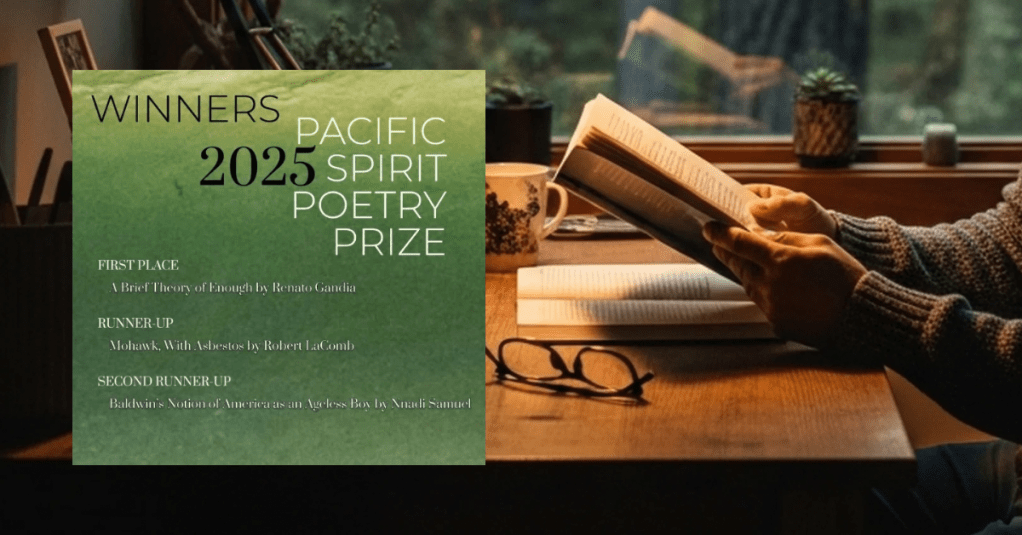
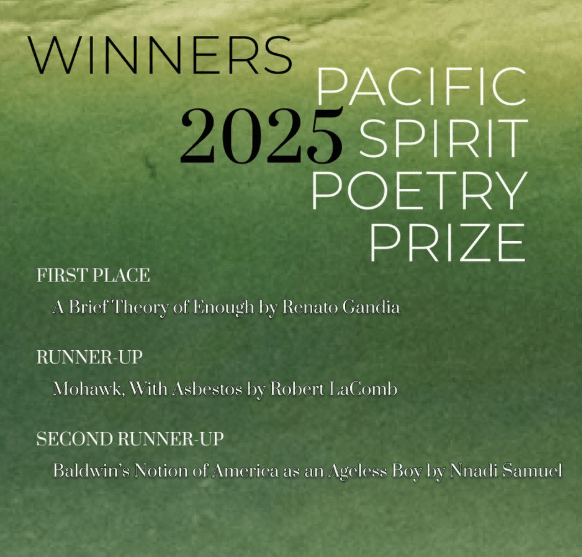
A few days ago, I received an email from PRISM international: I had won the 2025 Pacific Spirit Poetry Prize.
I read the message twice.
Then a third time, just to make sure I hadn’t misunderstood.
For writers, recognition arrives rarely and quietly. Most of the time we work in obscurity, sending poems out into the world like folded paper boats. Months pass. Often they sink without a trace. Occasionally one floats back with a polite rejection attached.
And sometimes — though not often — someone reads it and says yes.
Winning the Pacific Spirit Poetry Prize means a great deal to me. Not simply because it is a respected prize, though it certainly is. What moves me most is the reminder that a poem written in solitude can still reach someone far away.
A poem written in Calgary can travel to Vancouver and be heard.
These days, that feels especially meaningful.
If you live in Alberta and pay attention to the cultural atmosphere around writing, you know that the conversation around literature has grown uneasy. Libraries, schools, and public institutions increasingly find themselves pressured to justify what stories deserve to exist in public space. Writers who explore identity, sexuality, or politics often find themselves navigating an invisible boundary: what can be said, and what might provoke backlash.
The language used to describe this pressure is often bureaucratic. Words like alignment, policy, and guidelines appear where once there might simply have been curiosity or debate.
But writers recognize what is happening.
We recognize the tightening.
Literature has always lived in tension with authority. Poems ask inconvenient questions. Stories wander into the lives of people we are told not to understand. A single line of poetry can undo a comfortable narrative about who belongs and who does not.
Perhaps that is why poems matter.
Not because they shout, but because they refuse to disappear.
When I began writing seriously a couple of years ago, I did not imagine prizes or recognition. I was simply trying to make sense of my life — growing up Filipino, discovering my sexuality, wrestling with faith, migration, and memory. Poetry became a way to hold these contradictions without forcing them into neat conclusions.
Language allowed me to remain curious about my own life.
Many of the writers I admire most share that instinct. They write not to simplify the world but to reveal its complexity. They resist the tidy explanations that politics often demands.
The poem that won this prize — A Brief Theory of Enough — emerged from that same impulse. Like most poems, it began with a small observation, something ordinary that slowly opened into a larger question. I did not know where it would end when I started writing it.
I rarely do.
Poetry is one of the few art forms that still permits uncertainty.
You can write a poem without knowing what it means yet.
You can write a poem that contradicts itself.
You can write a poem that asks a question no one has answered before.
In times when public discourse feels increasingly rigid, that freedom becomes precious.
Winning the Pacific Spirit Poetry Prize feels like a quiet affirmation of that freedom.

It reminds me that editors and judges across this country are still reading with openness and care. They are still searching for language that unsettles, illuminates, or simply tells the truth in a new way.
That spirit is alive in Alberta too — in our readings, our classrooms, our literary magazines, and in the stubborn persistence of writers who continue to make art even as public conversations about books grow more anxious, more watchful, more eager to decide what should and should not be said.
That kind of attention is a gift.
I’m deeply grateful to the editors at PRISM international, and to Jillian Christmas, the judge who saw something in the poem that resonated. Their recognition does not end the long journey of writing — if anything, it reminds me how much work remains.
But it does offer a moment of encouragement.
A small light on the path.
For writers, encouragement matters more than people might realize. Writing can feel like speaking into a vast empty room. Days pass when nothing seems to move. Doubt creeps in. You wonder if the words matter at all.
Then suddenly a reader answers back.
The conversation begins again.
For now, I’m simply grateful.
Grateful that the poem found its way to someone.
Grateful that poetry still has the power to travel across distance.
And grateful that even in uncertain times, the quiet work of writing continues.
As an immigrant who grew up half a world away from here, I sometimes think about how unlikely it is that the words I write in Calgary could travel across this country and find readers at all. Poetry reminds me that language does not belong to any one place. It moves the way people do — quietly crossing borders, carrying memory, insisting on being heard.

 Renato Gandia