There are no delayed flights today.
Everything moves as it should. Boarding times hold. Gates change quietly. Screens update without disruption. The system performs its function with a kind of calm efficiency, as though nothing in the world were out of place.
And yet, no one seems at ease.
What I notice first is not the destinations, nor the languages, nor even the familiar clustering of Filipino families travelling together. What I notice is how many people are looking—not for their gate, not for their luggage, but for power.
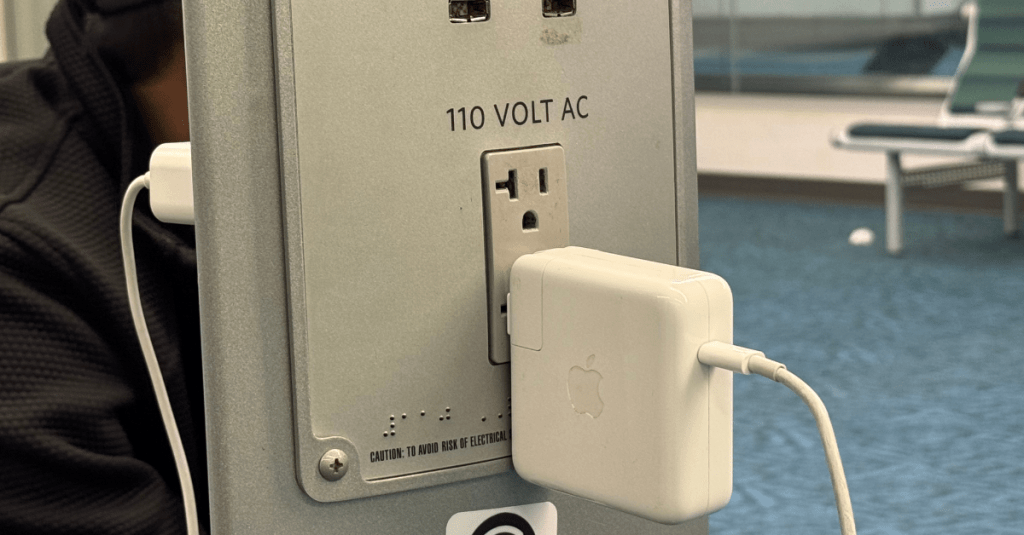
Outlets have become small territories. A socket on a column draws three people into its orbit. Knees bend, backs curve, bags are rearranged to make space for cords that must reach. Charging stations gather quiet crowds, each person tethered to a device that rests on a lap or the floor, as though proximity alone might hasten the return of energy.
There is a choreography to it. Arrive. Scan. Claim. Plug in. Wait.
We are all, it seems, running out of something.
In Waiting for Godot, the act of waiting is stripped of purpose. Nothing arrives. No event redeems the time spent. The waiting is the condition itself—endless, unresolved, quietly unbearable.
Here, everything arrives. Flights depart on time. Names are called. The future announces itself in orderly intervals. And still, the waiting feels the same.
I can count on one hand the number of people holding a book.
A woman scrolls through her phone with the focus of someone trying to keep pace with a life happening elsewhere. A man watches a film without headphones, the sound barely audible, his attention divided between the screen and the movement around him. A child taps repeatedly at a tablet, then taps again, as though the response is never quite fast enough.
No one is really still.
Even in waiting, we resist the fact of it.
There is a kind of urgency that persists beneath the surface, difficult to name but easy to recognize. It appears in the way people check their screens even when nothing has changed. In the way a dimming battery produces a small but immediate anxiety. In the way silence is filled at once, as though it were something to be corrected.
Perhaps this is what has shifted—not that we wait, but that we no longer know how.
Waiting once implied a pause that could not be negotiated away. A stretch of time that belonged to no one and demanded nothing. It opened, sometimes reluctantly, into reflection. Into memory. Into the slow and often uncomfortable recognition of one’s own thoughts.
Now, waiting is something to be managed. Optimized. Filled.
A device loses power and, with it, a layer of insulation. The world presses in more directly. The body becomes aware of its own stillness, its own placement in a room full of others who are similarly suspended. There is nothing to do but sit, to look, to think—or to avoid thinking.
And so we search again for power.
Not simply to remain connected, but to defer something quieter. Less visible. The possibility of being left alone with ourselves, even for a moment.
The few who read sit differently.
It is not that they are untouched by the same conditions, but they seem less governed by them. Their attention holds. Their bodies are less provisional, less ready to move at the first signal. They occupy their waiting rather than escaping it.
They are here.
The rest of us remain slightly elsewhere, our attention extended outward through cables and signals, our presence divided between the immediate and the distant.
The airport, for all its motion, is a place of suspension. No one has quite arrived, and no one has fully left. Time passes, but it does not accumulate in the usual way. It hovers.
Perhaps this is why waiting feels so difficult here. Not because nothing is happening, but because too much is implied. Departures. Returns. The lives we are moving toward and away from, held briefly in the same space.
We sit among one another, close enough to notice, far enough to remain separate. Each of us carrying a destination, a reason, a set of thoughts we may or may not be willing to face.
And so we plug in.
We keep the screens lit. We keep the current flowing. We give ourselves something to hold onto while time passes, as it inevitably will.
As it always has.

 Renato Gandia