When I see an email from a literary publication—subject line neutral, maybe even encouraging—my chest tightens before I click. I brace myself. I already know the script: Thank you for your submission, but…
My body recognizes the rhythm before my brain does: the slight recoil, the tightening of my jaw, the way my shoulders lift, as if rejection might pass me by if I simply took up less space.
So when the email opened with We loved your story and had one small request, I read it twice. Then a third time. It wasn’t a no. It wasn’t even a maybe. It was a yes with a caveat.
Would I be open, the editor asked, to changing the pronouns of one of my characters—a transwoman—from he/him to she/her?
The character is awaiting gender-affirming surgery. In my submitted draft, I had used he/him throughout—not because I didn’t see her as a woman, but because I wanted to write into a kind of emotional limbo. She was in that fraught, complicated space I’ve seen some trans friends describe: out in identity, affirmed by those close to them, but still perceived by the world in ways they can’t yet control. My intention was to reflect the social dissonance, the waiting, the quiet refusal to explain one’s becoming.
But the editor was right to pause. And I said yes, gladly.
Not because I was wrong and they were right—but because I was reminded. Because even when we try to write carefully, we can still carry the weight of language that doesn’t belong to us. Because intention doesn’t always protect someone from harm.
And because fiction, too, has consequences.
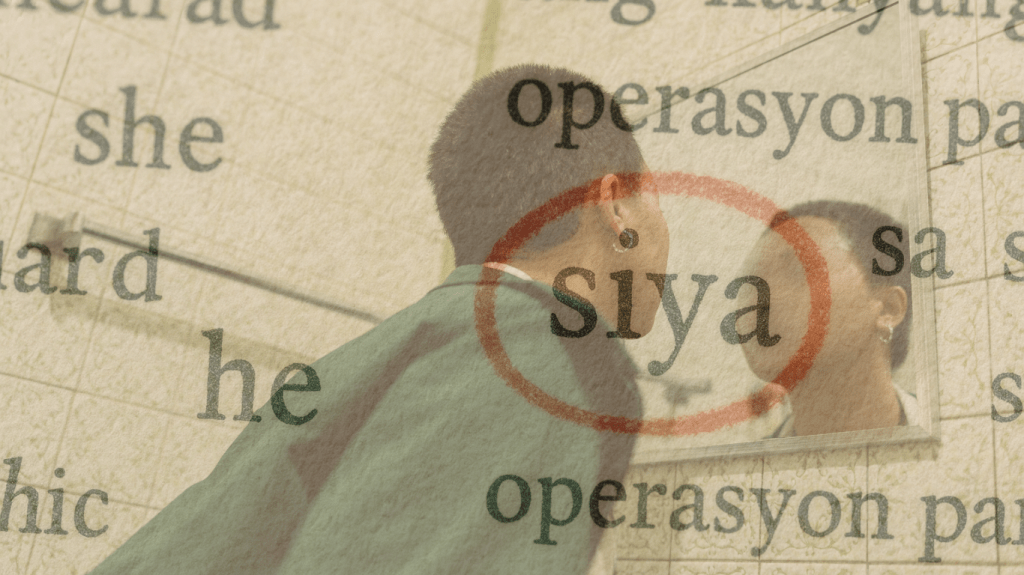
Growing up in the Philippines, I didn’t think much about gendered language. My first tongue was Tagalog. In Tagalog, we don’t gender our pronouns. The word siya means both he and she. Possession, too, is gender-neutral: kanya means his, hers, or theirs, depending on context. There are no masculine or feminine articles. No gendered suffixes. No need to linguistically assign pink or blue.
In other words, I was raised in a language that didn’t force binary choices on identity—at least most of the time. An exception is when we use proper names, which are often gendered through their endings: “o” for male and “a” for female, a convention influenced by Spanish naming traditions.
When I began writing in English, I didn’t realize how much I had taken that linguistic openness for granted. English, unlike Tagalog, demands decisions. It boxes people into he or she, his or hers, often with no room for in-between. Even as our understanding of gender has expanded, English remains a language that makes you choose—even when choosing feels inadequate, or even violent.
Scholar and poet Dr. J. Neil Garcia has written about how Tagalog’s gender neutrality can serve as both a liberating and limiting force in queer Filipino literature. In his essay “Philippine Gay Writing: History and Polemics,” Garcia notes that while gender-neutral pronouns might offer “a kind of linguistic safe space,” they can also function as a cloak—masking identity rather than affirming it. That ambiguity, he argues, can become a tool of erasure in a society still steeped in machismo and silence.
I think about that a lot—how language can both shelter and erase. How it can protect you from being misgendered, while also denying you the right to be seen.
When I write, I’m always straddling worlds. Linguistic ones. Cultural ones. Emotional ones. I write in English, but dream in Tagalog. I think in one language and ache in another. In one, gender is an obligation. In the other, it’s something you infer—or choose not to. This makes me, as a writer, constantly aware of what is lost in translation. And what can be reclaimed through it.
That editorial note wasn’t a correction—it was a conversation. A reminder that in a world where trans lives are endangered, where even language can be weaponized, choosing the right pronoun isn’t a trivial detail. It’s an act of respect. An editorial choice, yes. But also a political one. A human one.
I changed the pronouns. And as I reread the story with she/her in place, something shifted. The character I had written felt more whole. More certain. Her truth more stable on the page. I realized I had been holding her in a liminal space out of caution, maybe even fear. But in doing so, I had limited her too.
This, too, is part of the immigrant writer’s task: to examine the scaffolding of our language. To look at what we inherit, and ask what still serves us. What needs to be unlearned. In her book Minor Feelings, Cathy Park Hong writes: “If you’re an immigrant artist, your work is always being interpreted against your will. You’re always reacting, clarifying, defending.” I felt that. And in this case, I also felt something new: gratitude that someone else cared enough to interpret with me, not just for me.
There is a profound generosity in editing that aims not to flatten difference, but to hold it up to the light.
And so I’m learning to sit with that initial jolt—the fear that every email is a rejection. The gut-flinch that comes from years of silence, the instinct to apologize for existing in the wrong language, the wrong country, the wrong body.
But maybe not every email is a no.
Maybe some are invitations—to write again. To write better. To write more truthfully, even when the truth changes mid-sentence. Especially then.
Because the stories we tell are not just about who our characters are. They’re about who we choose to become as writers in the process.
And sometimes, becoming is just a pronoun away.


