The Verdict: Review
This performance of The Verdict feels less like a stage adaptation and more like a public reckoning. Produced by Vertigo Theatre and directed by Artistic Director Jack Grinhaus, the production transforms Barry Reed’s legal drama into something more unsettling than a legal thriller: a story about how institutions learn to protect themselves at the expense of the people they were built to serve.
Grinhaus describes the play as one that adds “how can we prove it?” to the familiar courtroom questions of “whodunnit” and “why.” That third question is where the production lives — and it is the most frightening of the three.
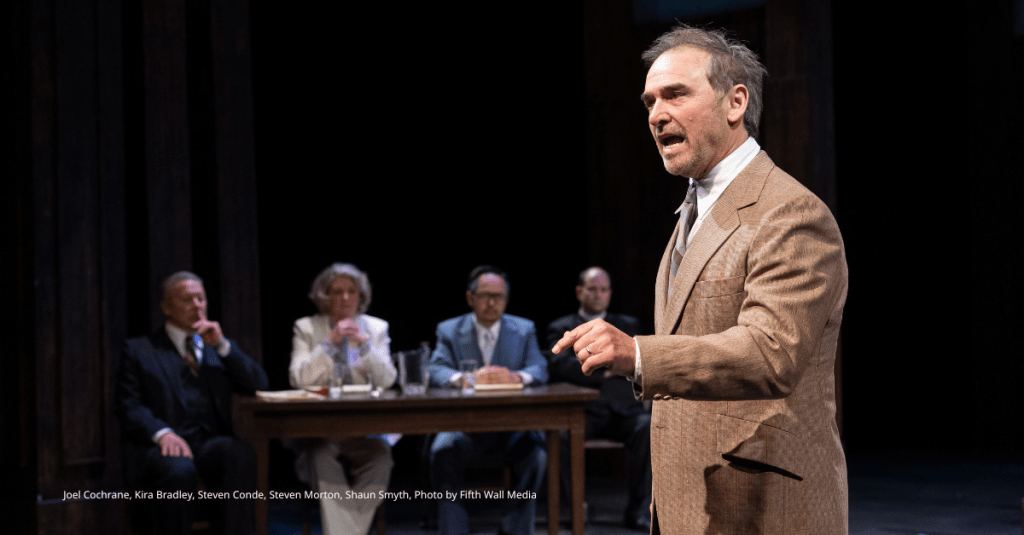
At the centre of the play is Frank Galvin, played by Shaun Smyth with the particular sadness of a man who knows exactly what he’s lost. Frank is introduced as a washed-up Boston lawyer scavenging funeral homes for clients while drinking himself into oblivion. He is bitter, self-destructive and compromised in ways the play doesn’t hurry to forgive.
One of the production’s earliest and most devastating scenes comes when Frank meets Deborah Ann Doherty’s mother, Mrs. McDaid, played by Shawna Burnett. As she describes her daughter lying alone in chronic care, she quietly instructs Frank where to sit beside the hospital bed: “Sit on the left-hand side of the bed, away from the tubes, respirator, and the drink waste.” The horror of Deborah’s condition accumulates through small practical devastations like this one.
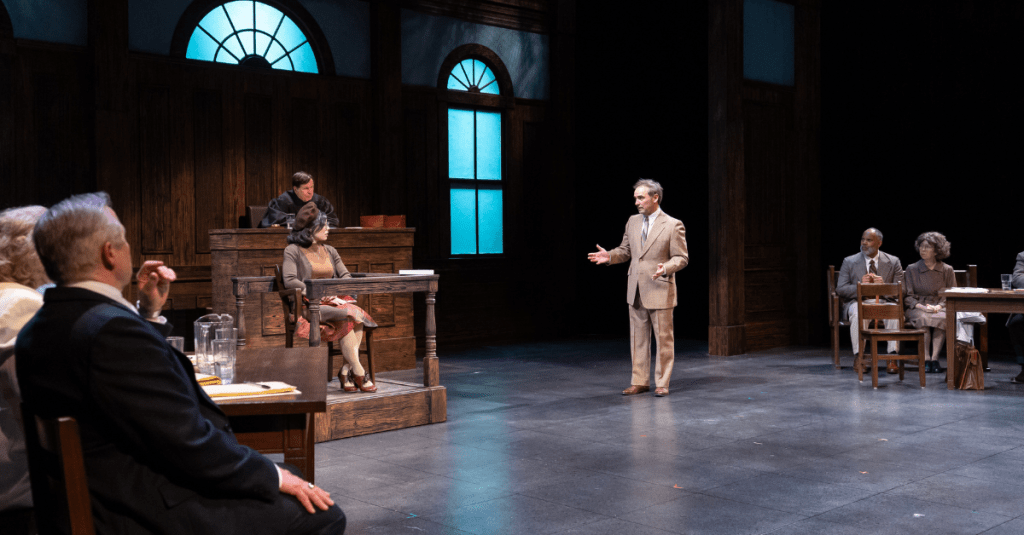
The cast of THE VERDICT, photo by Fifth Wall Media.
Burnett gives the evening some of its steadiest moments. Her Mrs. McDaid speaks with exhausted dignity, and later, as nurse Mary Rooney, she becomes the production’s most uncomfortable question: what does a good person do inside a system that has already decided what it will protect?
The production repeatedly returns to the image of Deborah as “a vegetable once for yes, and twice for no.” The play refuses euphemism. That refusal is what gives Deborah’s near-silent presence its weight — she becomes the moral centre around which every character rotates.
Smyth’s strongest moments come in the scenes between arguments, where Frank’s moral exhaustion collides with his conscience. After visiting Deborah in the hospital, he delivers one of the production’s most memorable monologues:
“The body shrinks in colour, did you know that? Collapses back into the fetal position… and all the time she stared back at me, doll’s eyes bulging from their sockets.”
Steven Morton gives Bishop Brophy a calm and unsettling authority. He plays the bishop as a man who has mistaken institutional logic for moral reasoning — and who cannot tell the difference. His line, “Morally and legally,” repeated during settlement negotiations, is sinister precisely because he seems to mean it.
The adaptation by Margaret May Hobbs keeps the original’s muscularity intact. Frank’s mentor Eugene Meehan, played by Christopher Clare, gets some of the script’s best cynical lines. Warning Frank against taking on the church and its elite legal team, he says:
“Those blue-blooded bastards will crucify you… We’re swimming with the sharks, and it’s their tank.”
Clare delivers it with the weary authority of someone who has already made his peace with losing.
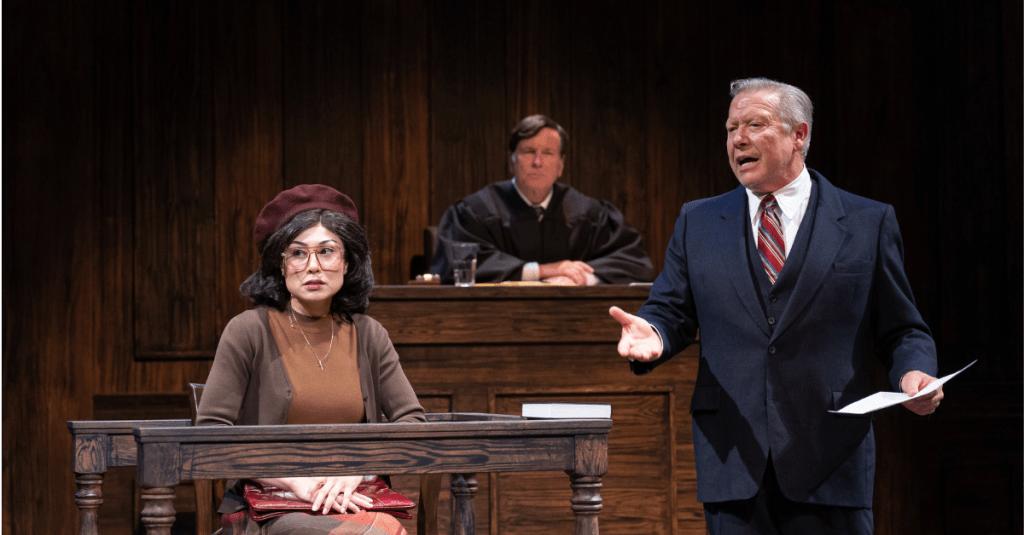
Kelsey Verzotti, Duval Lang, Joel Cochrane, Photo by Fifth Wall Media
Joel Cochrane’s J. Edgar Concannon is equally compelling. Cochrane gives him polish, terrifying confidence and the particular conviction of a man who has never had to question whose side the law is on. His courtroom composure becomes a weapon.
Meanwhile, Duval Lang’s Judge Sweeney injects volatility into the courtroom scenes, making even procedural exchanges feel dangerous. One of the evening’s most electric confrontations occurs when Frank finally erupts:
“You couldn’t hack it as a lawyer, and that’s why they stuck you in the robes!”
Smyth plays it as desperation rather than triumph — Frank knows he’s losing, and that knowledge is what makes the outburst land.
Kelsey Verzotti brings complexity and restraint to Donna St. Laurent and Natalie Stampanatto. Donna initially appears to offer Frank intimacy and escape from the pressure of the case, and Verzotti plays her with enough warmth and intelligence that when the role shifts, the audience feels the ground move.
The courtroom sequences are staged like psychological warfare. Kira Bradley’s Dr. Danielle Crowley and Steven Conde’s Dr. Rexford Towler speak with the fluency of people accustomed to authority, and the production is smart enough to make their certainty feel threatening rather than reassuring. The audience spends the trial unsure who to believe — which is exactly the right place to be.
Frank’s final argument contains perhaps the production’s defining line:
“No life should ever be small. Not yours. Not mine.”
The line earns its sentiment — and that’s a harder trick than it looks when the play has spent two hours demonstrating, with precision and without comfort, exactly how expendable some lives are made to feel.
The production’s technical design earns its place. Narda McCarroll’s set moves fluidly between bars, hospital corridors and courtrooms without calling attention to the transitions. Jessie Paynter’s lighting holds the contrast between intimacy and institutional coldness, while Miranda Martini’s sound design maintains a low-grade dread under the quieter scenes. Rebecca Toon’s costumes do the less glamorous work of marking class and profession without commentary.
What lingers after The Verdict is not the suspense but the sadness. People failed each other long before they entered a courtroom. Doctors failed a patient. Institutions failed the vulnerable. Frank failed himself. The production holds all of that without resolution — which is harder to watch than a verdict, and more honest.
The Verdict is not a play about whether justice prevails. It’s a play about whether one person can stand inside a broken system long enough to do one right thing. In that sense, it has never stopped being current.
Sometimes justice begins because one exhausted person finally decides not to look away.