
Vertigo Theatre’s The Lodger
There is a Filipino saying I kept thinking about while watching Vertigo Theatre’s The Lodger: Ang taong gipit, kahit sa patalim kumakapit.
A person in desperate circumstances will cling even to the blade of a knife.
It is a saying about what desperation does to judgment. When choices narrow, something dangerous can begin to look like salvation. We may recognize the blade for what it is and still reach for it because, at that moment, it appears to be the only thing within reach.
That, more than the question of who is committing the murders, stayed with me after The Lodger.
Written by Susie Moloney and Vern Thiessen, based on Marie Belloc Lowndes’s novel and inspired by Alfred Hitchcock’s 1927 silent film, The Lodger opens Vertigo Theatre’s 50th season. The adaptation relocates the story to a North American city in 1973, a period when fear of serial killers had begun to enter public consciousness.
At the centre of the story are Bill and Ellen Bunting, a couple struggling to make ends meet. When the mysterious Laurence Moore arrives looking for a room, taking in a lodger offers some desperately needed financial relief. Unfortunately, his arrival coincides with a series of murders of young women. Bill himself falls under suspicion, while Ellen begins to wonder about the stranger now living beneath their roof.
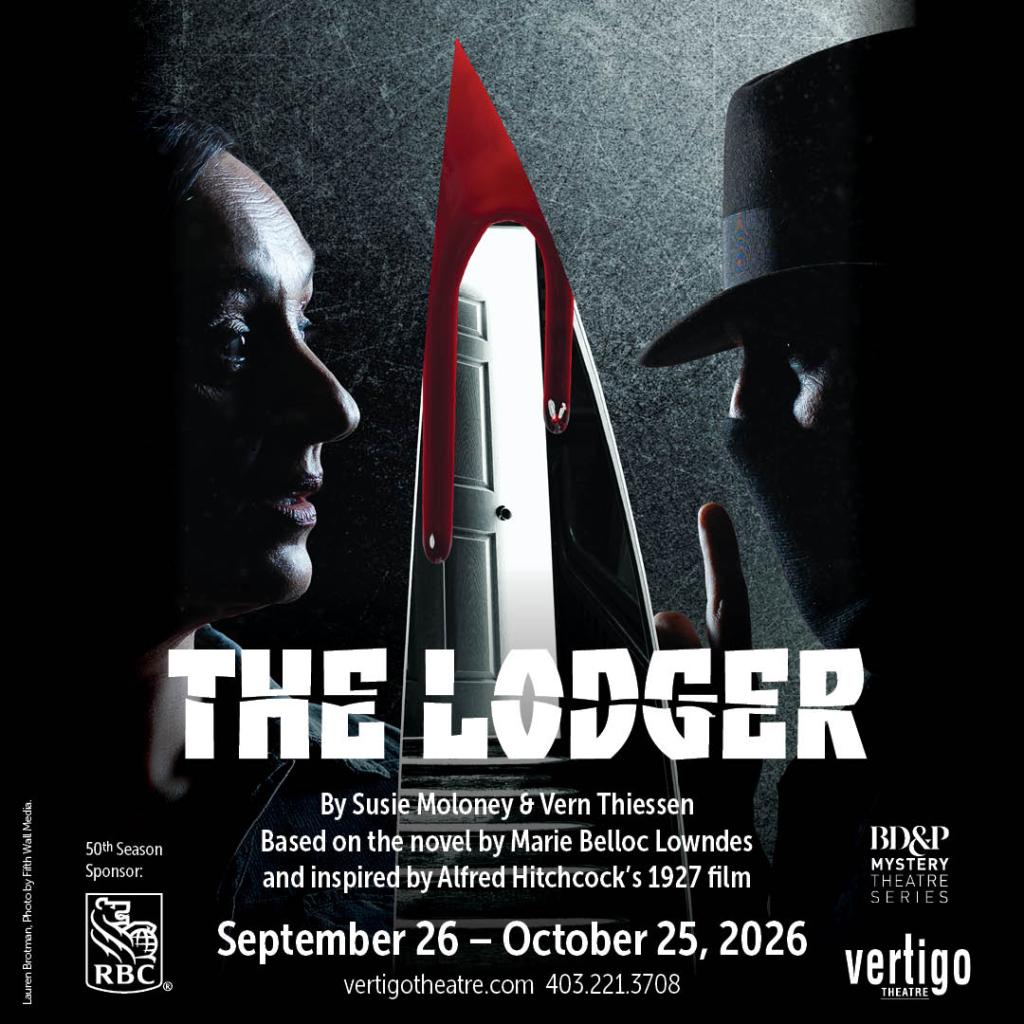
Given that the play is called The Lodger, it would be difficult to walk into the theatre without suspecting that the lodger might have something to do with all of this.
But that predictability does not necessarily work against the production. The more interesting tension comes from watching people negotiate what they know, what they suspect and what they are prepared—or compelled—to overlook.
The Buntings need the money.
That need matters.
Lauren Brotman gives Ellen a grounded believability that anchors the production. She is not simply the frightened woman of a conventional thriller. Brotman allows us to see someone negotiating necessity against instinct, trying to hold together a household even as her sense of safety begins to erode. Ellen has reasons to want the arrangement with Laurence to work, and every new suspicion therefore carries a cost.
David Haysom is equally convincing as Bill. Haysom and Brotman establish a relationship that feels lived in rather than created merely to service the mechanics of a murder mystery. Both actors also find the humour in the material, and those lighter moments are important. They allow the Bunting household to feel ordinary, even comfortable at times, which makes the encroaching danger more unsettling.
Tyrell Crews has a particularly tricky assignment as Laurence Moore. The title has already done some of the accusing before he even walks through the door. Crews therefore cannot depend simply on making Laurence mysterious or sinister. He has to make him believable enough that we understand why he is allowed to remain.
He does.
Crews moves effectively between the character’s more personable moments and the unease surrounding him. Like Brotman and Haysom, he also handles the production’s humour well without allowing it to puncture the suspense.
But The Lodger becomes particularly interesting in the different ways its women respond when vulnerability turns into danger.
Norma Lewis gives Joannie Buffie, Ellen’s childhood friend and a police officer investigating the murders, a protective determination. Her concern for Ellen and Daisy feels personal as much as professional. She is not simply there to deliver information about an investigation; Lewis makes us believe that Joannie is prepared to act when the people she loves are threatened.
Grace Fedorchuk’s Daisy brings another kind of determination. An ambitious young woman with plans for her own future, Daisy embodies some of the changing possibilities for women in the 1970s. Fedorchuk makes that ambition convincing rather than merely symbolic. And when Daisy is forced to show the mettle to fight for herself and for her life, it feels consistent with the young woman we have already come to know.
That gives the production’s women something more than the familiar role of potential victims in a serial-killer story. Ellen investigates. Joannie protects. Daisy fights.
Director Jack Grinhaus keeps these human relationships at the centre while allowing the production to deliver the pleasures expected of a thriller. Grinhaus has described The Lodger as both familiar and unfamiliar, a work in which audiences may sometimes see what is coming and yet can still be surprised. That seems an apt description of the experience. Suspense here does not depend entirely upon concealing the destination. Much of it comes from wondering how—and at what cost—the characters will get there.
The production’s design is especially effective in sustaining that suspense.
Scott Reid’s set is wonderfully convincing. That matters because The Lodger is, at heart, also a story about domestic space. A home is supposed to provide refuge from whatever dangers exist outside. Here, that certainty gradually disappears because the potential threat has already been invited in.
Reid creates a house that feels genuinely inhabited. That believability allows rooms, doors and thresholds to acquire their own tension. Once suspicion enters the house, the same familiar spaces begin to feel different.
Narda McCarroll’s lighting and the sound design and composition by MJ Dandeneau, with associate sound designer Samuel Kugbiyi, complement the set beautifully. Together, these elements understand that suspense is often less about what an audience sees than what it anticipates. A sound, a shadow or the knowledge that someone might be on the other side of a door can do considerably more than showing us the danger outright.
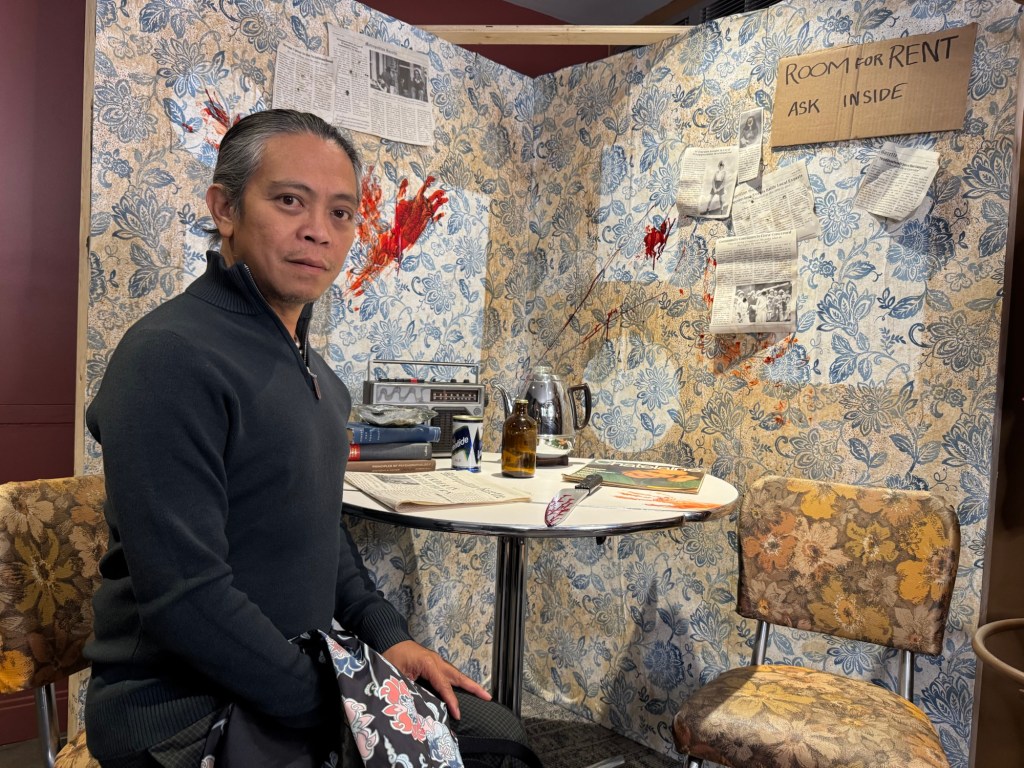
That visual world extends into the reception area, as it often does at Vertigo. The theatre regularly creates a set piece that echoes or extends the world audiences encounter onstage, inviting theatregoers to step into it and take photographs. I have always enjoyed that touch, and The Lodger provides another irresistible opportunity. I happily came away with photographs of my own.
It is a playful extension of a production whose central ideas are considerably darker.
Because beneath the murders, suspense and occasional laughter is a question about what people do when their circumstances leave them with few good choices.
The Buntings’ financial hardship is more than the narrative device required to put a suspicious stranger inside their house. It is what gives the story its moral pressure. Without that need, there may be no lodger. Without the lodger’s money, suspicion could be acted upon much more easily.
Necessity makes certainty expensive.
And that is why I kept returning to Ang taong gipit, kahit sa patalim kumakapit.
There is something particularly striking about the image contained in that Filipino saying. The knife is not disguised as something harmless. The desperate person reaches for it despite knowing it can cut.
The Lodger understands that danger can work much the same way. Sometimes we allow risk into our lives not because we cannot recognize it, but because circumstances have made rejecting it a luxury.
Yet the play does not leave its women there.
Ellen begins looking for answers. Joannie is ready to protect the people she loves. Daisy, when confronted with danger, proves willing to fight for herself. Their circumstances may make them vulnerable, but vulnerability and helplessness are not the same thing.
That distinction is what ultimately makes Vertigo Theatre’s The Lodger more satisfying than the simple question of whether the suspicious man upstairs is responsible for the bodies piling up outside.
Ang taong gipit, kahit sa patalim kumakapit.
Desperation may make us grasp the blade.
What matters next is whether we allow ourselves to be cut.
The Lodger runs at Vertigo Theatre through October 25.


