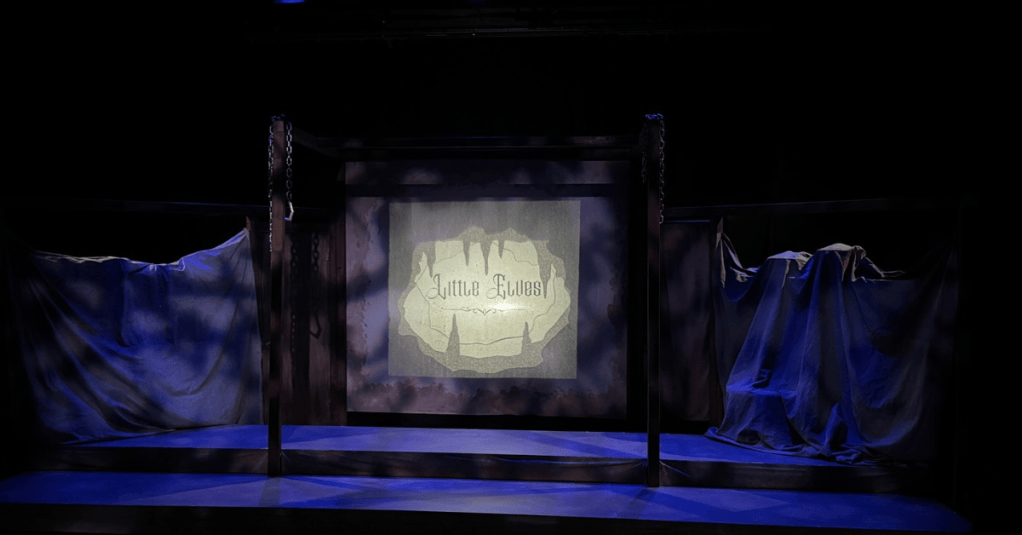
Fairy tales have always had a peculiar relationship with violence. Beneath their promises of happy endings lie abandoned children, murderous strangers, hungry monsters and communities eager to punish anyone who doesn’t belong. We tell these stories to children, perhaps because the distance of fantasy makes their cruelties easier to bear.
In Little Elves, a new musical co-produced by Calgary’s Chromatic Theatre and Handsome Alice Theatre, playwright Kodie Rollan and composer Alixandra Cowman take that familiar darkness and turn it toward something decidedly contemporary: anti-Asian racism, the pursuit of justice and the uncomfortable question of what people are prepared to do when survival demands more than innocence.
The result is an ambitious and affecting reimagining of the medieval legend of St. Nicholas and the Evil Butcher, one that challenges audiences to reconsider not only who gets cast as the monster but also who has the power to tell the story.
The original legend concerns three children murdered by a butcher and miraculously restored to life by St. Nicholas. Rollan’s version places three young Asian elves at the centre of the story, asking a provocative question: What if the story everyone believed was never the whole truth?
Having escaped a kidnapping, the elves find themselves in a town where suspicion and prejudice threaten their survival. Their struggle is no longer simply about escaping violence. It becomes a struggle over whose account of that violence will be believed.
Five years in development, Little Elves represents a significant undertaking for Calgary’s independent theatre community. It is Rollan’s first full-length musical and Chromatic Theatre’s largest production in its decade-long history. Co-directed by Rollan and Jenna Rodgers, the show brings together horror, humour, puppetry and original music in a production that is as interested in unsettling its audience as it is in entertaining them.
At its heart are three performers: Selina Wong, Safia Comtois-Mohamad and Isabella Pedersen.
Wong and Comtois-Mohamad are particularly impressive, their powerful singing voices bringing emotional intensity and conviction to the production. Pedersen complements them beautifully, blending seamlessly with her fellow performers. Together, the three establish a convincing musical and dramatic chemistry that gives the story much of its emotional force.
Their performances are especially important in a production that moves between the grotesque and the tender. The characters must navigate a world in which danger is ever-present, yet their relationships offer moments of warmth and humanity. The three actors make that contrast believable.
Cowman’s music is another of the production’s strengths. Drawing from folk, pop and rock traditions, the score moves comfortably between playful passages and emotionally charged numbers. Its three-part harmonies are particularly effective, allowing the performers’ voices to come together in ways that reinforce the musical’s recurring questions about community, belonging and survival.
During a conversation at intermission, Rollan described how the musical emerged from years of collaboration with Cowman, beginning during the COVID-19 pandemic. He would send scenes and rough melodies, sometimes recorded as voice notes, and Cowman would transform them into more elaborate compositions.
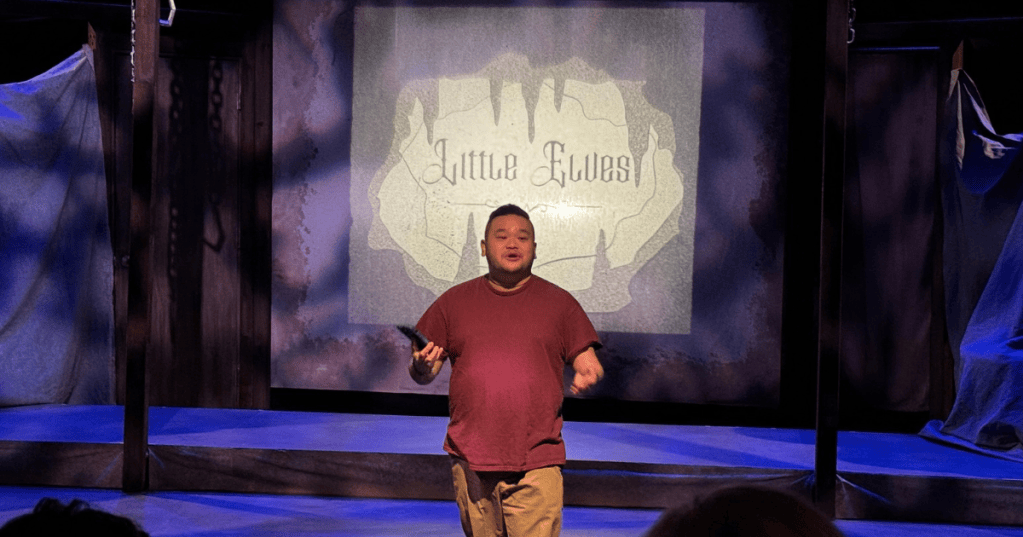
“I’m a four-chords-and-a-story kind of guy,” he said, laughing as he described how Cowman developed his musical sketches into intricate harmonies and arrangements.
The resulting score does more than accompany the action. It helps carry the story from its gruesome beginnings toward something unexpectedly hopeful.
Perhaps the musical’s greatest achievement is how convincingly Rollan and Cowman construct that journey, a transformation captured in the relationship between its opening and closing songs.
Little Elves begins with “Oh What You Don’t Know,” a title that immediately introduces the uncertainty surrounding the stories we hear and the assumptions we make. Along the way, songs such as “History (Where We’re From),” “The Lie” and “Did You Hear” deepen the musical’s examination of how stories are told, distorted and believed.
By the time the production reaches its powerful finale, “Now You Know,” the audience has travelled through a world of violence, prejudice, fear and difficult moral choices.
The two songs become bookends to a larger argument. What begins with what we don’t know ends with what we can no longer claim not to know.
That progression is especially effective because the musical doesn’t pretend that understanding automatically resolves injustice. Instead, it asks what responsibility comes with knowledge.
During our conversation, Rollan spoke about the questions that motivated him to create the work.
“How do we, as racialized individuals, specifically Asian people, deal with our own rage, our own conceptions of justice, and how do we build community with each other?” he asked.
It’s a question that extends well beyond the stage.
For Asian communities in Canada, the experience of being treated as perpetually foreign is hardly confined to history books. Anti-Asian legislation may belong to an earlier century, but the suspicion, resentment and hostility that sustained those laws have not entirely disappeared.
Rollan researched that history alongside European and pan-Asian folktales while developing the musical. He was particularly interested in the recurring monsters and shared fears that appear across different storytelling traditions.
What emerged was a theatrical world that resembles a frightening story told around a campfire, where the distance of fantasy makes difficult contemporary questions more accessible.
The approach works because Little Elves doesn’t reduce its characters to symbols of injustice. Their circumstances raise questions about the relationship between justice and vengeance, about the consequences of fear and about how communities can become complicit in the suffering of those they regard as outsiders.
When people have been subjected to violence, what constitutes a just response? When the vulnerable are treated as threats, who gets to determine the truth? And can the pursuit of justice reproduce the cruelty it seeks to overcome?
These are difficult questions, and the musical is wise enough not to offer easy answers.
Rollan told me he admires theatre that allows audiences to arrive at their own conclusions rather than prescribing what is right or wrong. By placing contemporary conflicts within a fantastical world, he hopes to create enough distance for audiences to confront uncomfortable truths.
That ambition is evident throughout Little Elves, but it finds its most compelling expression in the finale.
“Now You Know” is a powerful conclusion, not because it erases the horrors that preceded it, but because it allows hope to emerge from them.
The hope here isn’t the comforting certainty of a fairy-tale ending in which everything is forgiven and order is restored. It is something more demanding: the possibility that understanding can lead to change, that telling the truth can challenge injustice and that communities can find strength in refusing to remain silent.
The title itself carries a challenge.
Now You Know.
Knowledge, after all, comes with responsibility. Once we understand how prejudice operates, how stories are manipulated and how easily the vulnerable can become villains in someone else’s telling, we can no longer claim innocence through ignorance.
But Rollan and Cowman resist the temptation to tell us what to do with that understanding.
Is hope found in justice? In forgiveness? In solidarity? In the courage to confront the prejudices that shape our understanding of other people?
The audience must decide.
And perhaps that is where Little Elves finds its greatest strength. It recognizes that hope doesn’t require us to forget the violence of the past or look away from the injustices of the present. It asks us to see them clearly and consider what might be possible beyond them.
Asked what he learned from the years spent developing the musical, Rollan offered a simple answer: “Just be brave and do the thing.”
There is courage in creating theatre that confronts injustice without pretending to have solved it. There is courage, too, in trusting audiences to wrestle with uncomfortable questions.
For a company celebrating its 10th anniversary, Little Elves is a fitting demonstration of what independent theatre can accomplish when artistic ambition meets a willingness to take risks.
It begins by asking us to question the stories we have been told. It ends by asking us what kind of story we are prepared to tell next.
Now we know.
What happens next is up to us.
Little Elves runs until November 7, 2026, at the Victor Mitchell Theatre, Pumphouse Theatre, Calgary. The production is co-produced by Chromatic Theatre and Handsome Alice Theatre.


